THEOSOPHY CARDIFF
Please click here for Current Theosophical Events in
Cardiff
ELEMENTALS
From the
writings of Helena Petrovna Blavatsky, the
founder of
modern Theosophy and co-founder of the
original
Theosophical Society in
theosophycardiff@uwclub.net

____________________________
Cardiff
Theosophical Society
Mission
Statement
The
dominant and core activity of Cardiff Theosophical Society
is to
promote and assist the study of Theosophical Teachings
as
defined by the writings of Helena
Petrovna Blavatsky,
William Quan Judge, Alfred Percy Sinnett and
their lineage.
This
Mission Statement does not preclude non Theosophical
activities
but these must be of a spiritual nature
and/or
compatible with the Objects of the Society.
____________________________
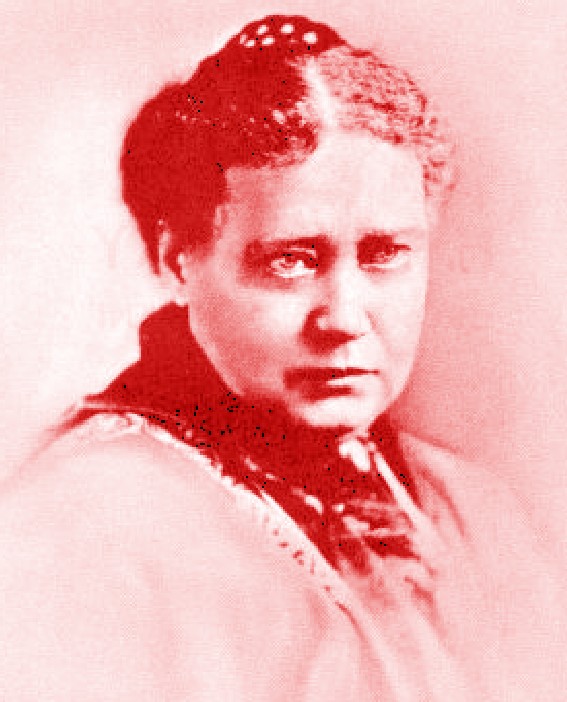
Helena
Petrovna Blavatsky
1831-1891
The
Founder of Modern Theosophy
Elementals
By
Helena Petrovna Blavatsky
I
THE
Universal Æther was not, in the eyes of the ancients, simply a tenantless
something, stretching throughout the expanse of heaven; it was for them a
boundless ocean, peopled like our familiar earthly seas, with Gods, Planetary
Spirits, monstrous and minor creatures, and having in its every molecule the
germs of life from the potential up to the most developed. Like the finny
tribes which swarm in our oceans and familiar bodies of water, each kind having
its habitat in some spot to which it is curiously adapted, some friendly, and
some inimical to man, some pleasant and some frightful to behold, some seeking
the refuge of quiet nooks and land-locked harbours, and some traversing great
areas of water; so the various races of the Planetary, Elemental, and other Spirits,
were believed by them to inhabit the different portions of the great ethereal
ocean, and to be exactly adapted to their respective conditions.
According
to the ancient doctrines, every member of this varied ethereal population, from
the highest "Gods" down to the soulless Elementals, was evolved by
the ceaseless motion inherent in the astral light. Light is force, and the
latter is produced by the will. As this will proceeds from an intelligence
which cannot err, for it is absolute and immutable and has nothing of the
material organs of human thought in it, being the superfine pure emanation of
the ONE LIFE itself, it proceeds from the beginning of time, according to
immutable laws, to evolve the elementary fabric requisite for subsequent generations
of what we term human races. All of the latter, whether belonging to this
planet or to some other of the myriads in space, have their earthly bodies
evolved in this matrix out of the bodies of a certain class of these elemental
beings--the primordial germ of Gods and men--which have passed away into the
visible worlds. In the Ancient Philosophy there was no missing link to be
supplied by what Tyndall calls an "educated imagination"; no hiatus
to be filled with volumes of materialistic speculations made necessary by the
absurd attempt to solve an equation with but one set of quantities; our
"ignorant" ancestors traced the law of evolution throughout the whole
universe. As by gradual progression from the star-cloudlet to the development
of the physical body of man, the rule holds good, so from the Universal Æther
to the incarnate human spirit, they traced one uninterrupted series of
entities. These evolutions were from the world of Spirit into the world of
gross Matter: and through that back again to the source of all things. The
"descent of species" was to them a descent from the Spirit, primal
source of all, to the "degradation of Matter." In this complete chain
of unfoldings the elementary, spiritual beings had as distinct a place, midway
between the extremes, as Mr. Darwin's missing-link between the ape and man.
No
author in the world of literature ever gave a more truthful or more poetical
description of these beings than Sir E. Bulwer-Lytton, the author of Zanoni.
Now, himself "a thing not of matter" but an "idea of joy and
light," his words sound more like the faithful echo of memory than the
exuberant outflow of mere imagination. He makes the wise Mejnour say to
Glyndon:
Man
is arrogant in proportion of his ignorance. For several ages he saw in the
countless worlds that sparkle through space like the bubbles of a shoreless
ocean, only the petty candles . . . that Providence has been pleased to light
for no other purpose but to make the night more agreeable to man. . . .
Astronomy has corrected this delusion of human vanity, and man now reluctantly
confesses that the stars are worlds, larger and more glorious than his own. . .
. Everywhere, in this immense design, science brings new life to light. . . .
Reasoning, then, by evident analogy, if not a leaf, if not a drop of water, but
is, no less than yonder star, a habitable and breathing world--nay, if even man
himself is a world to other lives, and millions and myriads dwell in the rivers
of his blood, and inhabit man's frame, as man inhabits earth--common sense (if
our schoolmen had it) would suffice to teach that the circumfluent infinite
which you call space--the boundless impalpable which divides earth from the
moon and stars--is filled also with its correspondent and appropriate life. Is
it not a visible absurdity to suppose that being is crowded upon every leaf,
and yet absent from the immensities of space! The law of the great system
forbids the waste even of an atom; it knows no spot where something of life
does not breathe. . . . Well, then, can you conceive that space, which is the
infinite itself, is alone a waste, is alone lifeless, is less useful to the one
design of universal being . . . than the peopled leaf, than the swarming
globule? The microscope shows you the creatures on the leaf; no mechanical tube
is yet invented to discover the nobler and more gifted things that hover in the
illimitable air. Yet between these last and man is a mysterious and terrible
affinity. . . . But first, to penetrate this barrier, the soul with which you
listen must be sharpened by intense enthusiasm, purified from all earthly
desires. . . . When thus prepared, science can be brought to aid it; the sight
itself may be rendered more subtile, the nerves more acute, the spirit more
alive and outward, and the element itself--the air, the space--may be made, by
certain secrets of the higher chemistry, more palpable and clear. And this,
too, is not Magic as the credulous call it; as I have so often said before,
Magic (a science that violates Nature) exists not; it is but the science by
which Nature can be controlled. Now, in space there are millions of beings, not
literally spiritual, for they have all, like the animalculæ unseen by the naked
eye, certain forms of matter, though matter so delicate, air-drawn, and subtile,
that it is, as it were, but a film, a gossamer, that clothes the spirit. . . .
Yet, in truth, these races differ most widely . . . some of surpassing wisdom,
some of horrible malignity; some hostile as fiends to men, others gentle as
messengers between earth and heaven.1
Such
is the insufficient sketch of Elemental Beings void of Divine Spirit, given by
one whom many with reason believed to know more than he was prepared to admit
in the face of an incredulous public. We have underlined the few lines than
which nothing can be more graphically descriptive. An Initiate, having a
personal knowledge of these creatures, could do no better.
We
may pass now to the "Gods," or Daimons, of the ancient Egyptians and
Greeks, and from these to the Devas and Pitris of the still more ancient Hindû
Âryans.
Who
or what were the Gods, or Daimonia, of the Greeks and Romans? The name has
since then been monopolized and disfigured to their own use by the Christian
Fathers. Ever following in the footsteps of old Pagan Philosophers on the
well-trodden highway of their speculations, while, as ever, trying to pass
these off as new tracks on virgin soil, and themselves as the first pioneers in
a hitherto pathless forest of eternal truths--they repeated the Zoroastrian
ruse: to make a clean sweep of all the Hindû Gods and Deities, Zoroaster had
called them all Devs, and adopted the name as designating only evil powers. So
did the Christian Fathers. They applied the sacred name of Daimonia--the divine
Egos of man--to their devils, a fiction of diseased brains, and thus
dishonoured the anthropomorphized symbols of the natural sciences of wise
antiquity, and made them all loathesome in the sight of the ignorant and the
unlearned.
What
the Gods and Daimonia, or Daimons, really were, we may learn from Socrates,
Plato, Plutarch, and many other renowned Sages and Philosophers of
pre-Christian, as well as post-Christian days. We will give some of their
views.
Xenocrates,
who expounded many of the unwritten theories and teachings of his master, and
who surpassed Plato in his definition of the doctrine of invisible magnitudes,
taught that the Daimons are intermediate beings between the divine perfection
and human sinfulness,2 and he divides them into classes, each subdivided into
many others. But he states expressly that the individual or personal Soul is
the leading guardian Daimon of every man, and that no Daimon has more power
over us than our own. Thus the Daimonion of Socrates is the God or Divine
Entity which inspired him all his life. It depends on man either to open or
close his perceptions to the Divine voice.
Heracleides,
who adopted fully the Pythagorean and Platonic views of the human Soul, its
nature and faculties, speaking of Spirits, calls them "Daimons with airy
and vaporous bodies," and affirms that Souls inhabit the Milky Way before
descending "into generation" or sublunary existence.
Again,
when the author of Epinomis locates between the highest and lowest Gods
(embodied Souls) three classes of Daimons, and peoples the universe with
invisible beings, he is more rational than either our modern Scientists, who
make between the two extremes one vast hiatus of being, the playground of blind
forces, or the Christian Theologians, who call every pagan God, a dæmon, or
devil. Of these three classes the first two are invisible; their bodies are
pure ether and fire (Planetary Spirits); the Daimons of the third class are
clothed with vapoury bodies; they are usually invisible, but sometimes, making
themselves concrete, become visible for a few seconds. These are the earthly
spirits, or our astral souls.
The
fact is, that the word Daimon was given by the ancients, and especially by the
Philosophers of the Alexandrian school, to all kinds of spirits, whether good
or bad, human or otherwise, but the appellation was often synonymous with that
of Gods or angels. For instance, the "Samothraces" was a designation
of the Fane-gods; worshipped at Samothracia in the Mysteries. They are
considered as identical with the Cabeiri, Dioscuri, and Corybantes. Their names
were mystical--denoting Pluto, Ceres or Proserpina, Bacchus, and Æsculapius or
Hermes, and they were all referred to as Daimons.
Apuleius,
speaking in the same symbolical and veiled language, of the two Souls, the human
and the divine, says:
The
human soul is a demon that our language may name genius. She is an immortal
god, though in a certain sense she is born at the same time as the man in whom
she is. Consequently, we may say that she dies in the same way that she is
born.
Eminent
men were also called Gods by the ancients. Deified during life, even their
"shells" were reverenced during a part of the Mysteries. Belief in
Gods, in Larvæ and Umbræ, was a universal belief then, as it is fast
becoming--now. Even the greatest Philosophers, men who have passed to posterity
as the hardest Materialists and Atheists--only because they rejected the
grotesque idea of a personal extra-cosmic God--such as Epicurus, for instance,
believed in Gods and invisible beings. Going far back into antiquity, out of
the great body of Philosophers of the pre-Christian ages, we may mention
Cicero, as one who can least be accused of superstition and credulity. Speaking
of those whom he calls Gods and who are either human or atmospheric spirits, he
says:
We
know that of all livings beings man is the best formed, and, as the gods belong
to this number, they must have a human form. . . . I do not mean to say that
the gods have body and blood in them; but I say that they seem as if they had bodies
with blood in them. . . . Epicurus, for whom hidden things were as tangible as
if he had touched them with his finger, teaches us that gods are not generally
visible, but that they are intelligible; that they are not bodies having a
certain solidity . . . but that we can recognize them by their passing images;
that as there are atoms enough in the infinite space to produce such images,
these are produced before us . . . and make us realize what are these happy,
immortal beings.3
If,
turning from Greece and Egypt to the cradle of universal civilization, India,
we interrogate the Brâhmans and their most admirable Philosophies, we find them
calling their Gods and their Daimonia by such a number and variety of
appellations, that the thirty-three millions of these Deities would require a
whole library to contain only their names and attributes. We will choose for
the present time only two names out of the Pantheon. These groups are the most
important as well as the least understood by the Orientalists--their true
nature having been all along wrapped in obscurity by the unwillingness of the
Brâhmans to divulge their philosophical secrets. We will speak of but the Devas
and the Pitris.
The
former aerial beings are some of them superior, others inferior, to man. The
term means literally the Shining Ones, the resplendent; and it covers spiritual
beings of various degrees, including entities from previous planetary periods,
who take active part in the formation of new solar systems and the training of
infant humanities, as well as unprogressed Planetary Spirits, who will, at
spiritualistic séances, simulate human deities and even characters on the stage
of human history.
As
to the Deva Yonis, they are Elementals of a lower kind in comparison with the
Kosmic "Gods," and are subjected to the will of even the sorcerer. To
this class belong the gnomes, sylphs, fairies, djins, etc. They are the Soul of
the elements, the capricious forces in Nature, acting under one immutable Law,
inherent in these Centres of Force, with undeveloped consciousness and bodies
of plastic mould, which can be shaped according to the conscious or unconscious
will of the human being who puts himself en rapport with them. It is by
attracting some of the beings of this class that our modern spiritualistic
mediums invest the fading shells of deceased human beings with a kind of
individual force. These beings have never been, but will, in myriads of ages
hence, be evolved into men. They belong to the three lower kingdoms, and
pertain to the Mysteries on account of their dangerous nature.
We
have found a very erroneous opinion gaining ground not only among
Spiritualists--who see the spirits of their disembodied fellow creatures
everywhere--but even among several Orientalists who ought to know better. It is
generally believed by them that the Sanskrit term Pitris means the spirits of
our direct ancestors; of disembodied people. Hence the argument of some
Spiritualists that fakirs, and other Eastern wonder-workers, are mediums; that
they themselves confess to being unable to produce anything without the help of
the Pitris, of whom they are the obedient instruments. This is in more than one
sense erroneous, the error being first started, we believe, by M. L. Jacolliot,
in his Spiritisme dans le Monde, and Govinda Swami; or, as he spells it,
"the fakir Kovindasami's" phenomena. The Pitris are not the ancestors
of the present living men, but those of the human kind or primitive race; the
spirits of human races which, on the great scale of descending evolution,
preceded our races of men, and were physically, as well as spiritually, far
superior to our modern pigmies. In Mânava-Dharma-Shâstra they are called the
Lunar Ancestors. The Hindû--least of all the proud Brâhman--has no such great
longing to return to this land of exile after he has shaken off his mortal
coil, as has the average Spiritualist; nor has death for him any of the great
terrors it has for the Christian. Thus, the most highly developed minds in
India will always take care to declare, while in the act of leaving their
tenements of clay, "Nachapunarâvarti," "I shall not come
back," and by this very declaration is placed beyond the reach of any
living man or medium. But, it may be asked, what then is meant by the Pitris? They
are Devas, lunar and solar, closely connected with human evolution, for the
Lunar Pitris are they who gave their Chhâyâs as the models of the First Race in
the Fourth Round, while the Solar Pitris endowed mankind with intellect. Not
only so, but these Lunar Devas passed through all the kingdoms of the
terrestrial Chain in the First Round, and during the Second and Third Rounds
"lead and represent the human element."4
A
brief examination of the part they play will prevent all future confusion in
the student's mind between the Pitris and the Elementals. In the Rig Veda,
Vishnu (or the pervading Fire, Æther) is shown first striding through the seven
regions of the World in three steps, being a manifestation of the Central Sun.
Later on, he becomes a manifestation of our solar energy, and is connected with
the septenary form and with the Gods, Agni, Indra and other solar deities.
Therefore, while the "Sons of Fire," the primeval Seven of our
System, emanate from the primordial Flame, the "Seven Builders" of
our Planetary Chain are the "Mind-born Sons" of the latter,
and--their instructors likewise. For, though in one sense they are all Gods and
are all called Pitris (Pitara, Patres, Fathers), a great though very subtle
distinction (quite Occult) is made which must be noticed. In the Rig Veda they
are divided into two classes--the Pitris Agni-dagdha ("Fire-givers"),
and the pitris Anagni-dagdha ("non-Fire-givers")5 i.e., as explained
exoterically--Pitris who sacrificed to the Gods and those who refused to do so
at the "fire-sacrifice." But the Esoteric and true meaning is the
following. The first or primordial Pitris, the "Seven Sons of Fire"
or of the Flame, are distinguished or divided into seven classes (like the
Seven Sephiroth, and others, see Vâyu Purâna and Harivamsha, also Rig Veda);
three of which classes are Arûpa, formless, "composed of intellectual not
elementary substance," and four are corporeal. The first are pure Agni
(fire) or Sapta-jiva ("seven lives," now become Sapta-jihva,
seven-tongued, as Agni is represented with seven tongues and seven winds as the
wheels of his car). As a formless, purely spiritual essence, in the first
degree of evolution, they could not create that, the prototypical form of which
was not in their minds, as this is the first requisite. They could only give
birth to "mind-born" beings, their "Sons," the second class
of Pitris (or Prajâpati, or Rishis, etc.), one degree more material; these, to
the third--the last of the Arûpa class. It is only this last class that was
enabled with the help of the Fourth principle of the Universal Soul (Aditi,
Âkâsha) to produce beings that became objective and having a form.6 But when
these came to existence, they were found to possess such a small proportion of
the divine immortal Soul or Fire in them, that they were considered failures.
"The third appealed to the second, the second to the first, and the Three
had to become Four (the perfect square or cube representing the 'Circle
Squared' or immersion of pure Spirit), before the first could be instructed"
(Sansk. Comment.). Then only, could perfect Beings--intellectually and
physically--be shaped. This, though more philosophical, is still an allegory.
But its meaning is plain, however absurd may seem the explanation from a
scientific standpoint. The Doctrine teaches the Presence of a Universal Life
(or motion) within which all is, and nothing outside of it can be. This is pure
Spirit. Its manifested aspect is cosmic primordial Matter coeval with, since it
is, itself. Semi-spiritual in comparison to the first, this vehicle of the
Spirit-Life is what Science calls Ether, which fills the boundless space, and
it is in this substance, the world-stuff, that germinates all the atoms and
molecules of what is called matter. However homogeneous in its eternal origin,
this Universal Element, once that its radiations were thrown into the space of
the (to be) manifested Universe, the centripetal and centrifugal forces of
perpetual motion, of attraction and repulsion, would soon polarize its
scattered particles, endowing them with peculiar properties now regarded by
Science as various elements distinct from each other. As a homogeneous whole,
the world-stuff in its primordial state is perfect; disintegrated, it loses its
property of conditionless creative power; it has to associate with its
contraries. Thus, the first worlds and Cosmic Beings, save the
"Self-Existent"--a mystery no one could attempt to touch upon
seriously, as it is a mystery perceived by the divine eye of the highest
Initiates, but one that no human language could explain to the children of our
age--the first worlds and Beings were failures; inasmuch as the former lacked
that inherent creative force in them necessary for their further and
independent evolution, and that the first orders of Beings lacked the immortal
soul. Part and parcel of Anima Mundi in its Prâkritic aspect, the Purusha
element in them was too weak to allow of any consciousness in the intervals
(entr' actes) between their existences during the evolutionary period and the
cycle of Life. The three orders of Beings, the Pitri-Rishis, the Sons of Flame,
had to merge and blend together their three higher principles with the Fourth
(the Circle), and the Fifth (the microcosmic) principle before the necessary
union could be obtained and result therefrom achieved. "There were old
worlds, which perished as soon as they came into existence; were formless, as
they were called sparks. These sparks are the primordial worlds which could not
continue because the Sacred Aged had not as yet assumed the form"7 (of perfect
contraries not only in opposite sexes but of cosmical polarity). "Why were
these primordial worlds destroyed? Because," answers the Zohar, "the
man represented by the ten Sephiroth was not as yet. The human form contains
everything {spirit, soul and body}, and as it did not as yet exist the worlds
were destroyed."
Far
removed from the Pitris, then, it will readily be seen are all the various
feats of Indian fakirs, jugglers and others, phenomena a hundred times more
various and astounding than are ever seen in civilized Europe and America. The
Pitris have naught to do with such public exhibitions, nor are the
"spirits of the departed" concerned in them. We have but to consult
the lists of the principal Daimons or Elemental Spirits to find that their very
names indicate their professions, or, to express it clearly, the tricks for
which each variety is best adapted. So we have the Mâdan, a generic name
indicating wicked elemental spirits, half brutes, half monsters, for Mâdan
signifies one that looks like a cow. He is the friend of the malicious
sorcerers and helps them to effect their evil purposes of revenge by striking
men and cattle with sudden illness and death.
The
Shudâla-Mâdan, or graveyard fiend, answers to our ghouls. He delights where
crime and murder were committed, near burial-spots and places of execution. He
helps the juggler in all the fire phenomena as well as Kutti Shâttan, the
little juggling imps. Shudâla, they say, is a half-fire, half-water demon, for
he received from Shiva permission to assume any shape he chose, to transform
one thing into another; and when he is not in fire, he is in water. It is he
who blinds people "to see that which they do not see." Shûla Mâdan is
another mischievous spook. He is the furnace-demon, skilled in pottery and
baking. If you keep friends with him, he will not injure you; but woe to him
who incurs his wrath. Shûla likes compliments and flattery, and as he generally
keeps underground it is to him that a juggler must look to help him raise a
tree from a seed in a quarter of an hour and ripen its fruit.
Kumil-Mâdan,
is the undine proper. He is an Elemental Spirit of the water, and his name
means blowing like a bubble. He is a very merry imp, and will help a friend in
anything relative to his department; he will shower rain and show the future
and the present to those who will resort to hydromancy or divination by water.
Poruthû
Mâdan is the "wrestling" demon; he is the strongest of all; and
whenever there are feats shown in which physical force is required, such as
levitations, or taming of wild animals, he will help the performer by keeping
him above the soil, or will over-power a wild beast before the tamer has time
to utter his incantation. So, every "physical manifestation" has its
own class of Elemental Spirits to superintend it. Besides these there are in
India the Pisâchas, Daimons of the races of the gnomes, the giants and the
vampires; the Gandharvas, good Daimons, celestial seraphs, singers; and Asuras
and Nâgas, the Titanic spirits and the dragon or serpent-headed spirits.
These
must not be confused with Elementaries, the souls and shells of departed human
beings; and here again we have to distinguish between what has been called the
astral soul, i.e., the lower part of the dual Fifth Principle, joined to the
animal, and the true Ego. For the doctrine of the Initiates is that no astral
soul, even that of a pure, good, and virtuous man, is immortal in the strictest
sense, "from elements it was formed--to elements it must return." We
may stop here and say no more: every learned Brâhman, every Chelâ and
thoughtful Theosophist will understand why. For he knows that while the soul of
the wicked vanishes, and is absorbed without redemption, that of every other
person, even moderately pure, simply changes its ethereal particles for still
more ethereal ones; and, while there remains in it a spark of the Divine, the
god-like man, or rather, his individual Ego, cannot die. Says Proclus:
After
death, the soul (the spirit) continueth to linger in the aërial body (astral
form), till it is entirely purified from all angry and voluptuous passions . .
. then doth it put off by a second dying the aërial body as it did the earthly
one. Whereupon, the ancients say that there is a celestial body always joined with
the soul, which is immortal, luminous, and star-like—
while
the purely human soul or the lower part of the Fifth Principle is not. The
above explanations and the meaning and the real attributes and mission of the Pitris,
may help to better understand this passage of Plutarch:
And
of these souls the moon is the element, because souls resolve into her, as the
bodies of the deceased do into earth. Those, indeed, who have been virtuous and
honest, living a quiet and philosophical life, without embroiling themselves in
troublesome affairs, are quickly resolved; being left by the nous
(understanding) and no longer using the corporeal passions, they incontinently
vanish away.8
The
ancient Egyptians, who derived their knowledge from the Âryans of India, pushed
their researches far into the kingdoms of the "elemental" and
"elementary" beings. Modern archæologists have decided that the
figures found depicted on the various papyri of The Book of the Dead, or other
symbols relating to other subjects painted upon their mummy cases, the walls of
their subterranean temples and sculptured on their buildings, are merely
fanciful representations of their Gods on the one hand, and on the other, a
proof of the worship by the Egyptians of cats, dogs, and all manner of creeping
things. This modern idea is wholly wrong, and arises from ignorance of the
astral world and its strange denizens.
There
are many distinct classes of "Elementaries" and
"E1ementals." The highest of the former in intelligence and cunning
are the so-called "terrestrial spirits." Of these it must suffice to
say, for the present, that they are the Larvæ, or shadows of those who have
lived on earth, alike of the good and of the bad. They are the lower principles
of all disembodied beings, and may be divided into three general groups. The
first are they who having refused all spiritual light, have died deeply
immersed in the mire of matter, and from whose sinful Souls the immortal Spirit
has gradually separated itself. These are, properly, the disembodied Souls of
the depraved; these Souls having at some time prior to death separated
themselves from their divine Spirits, and so lost their chance of immortality.
Eliphas Levi and some other Kabalists make little, if any, distinction between
Elementary Spirits who have been men, and those beings which people the
elements, and are the blind forces of nature. Once divorced from their bodies,
these Souls (also called "astral bodies"), especially those of purely
materialistic persons, are irresistibly attracted to the earth, where they live
a temporary and finite life amid elements congenial to their gross natures.
From having never, during their natural lives, cultivated their spirituality,
but subordinated it to the material and gross, they are now unfitted for the
lofty career of the pure, disembodied being, for whom the atmosphere of earth
is stifling and mephitic. Its attractions are not only away from earth, but it
cannot, even if it would, owing to its Devachanic condition, have aught to do
with earth and its denizens consciously. Exceptions to this rule will be
pointed out later on. After a more or less prolonged period of time these
material souls will begin to disintegrate, and finally, like a column of mist,
be dissolved, atom by atom, in the surrounding elements.
These
are the "shells" which remain the longest period in the Kâma Loka;
all saturated with terrestrial effluvia, their Kâma Rûpa (body of desire) thick
with sensuality and made impenetrable to the spiritualizing influence of their
higher principles, endures longer and fades out with difficulty. We are taught
that these remain for centuries sometimes, before the final disintegration into
their respective elements.
The
second group includes all those, who, having had their common share of
spirituality, have yet been more or less attached to things earthly and
terrestrial life, having their aspirations and affections more centred on earth
than in heaven; the stay in Kâma Loka of the reliquiæ of this class or group of
men, who belonged to the average human being, is of a far shorter duration, yet
long in itself and proportionate to the intensity of their desire for life.
Remains,
as a third class, the disembodied souls of those whose bodies have perished by
violence, and these are men in all save the physical body, till their life-span
is complete.
Among
Elementaries are also reckoned by Kabalists what we have called psychic
embryos, the "privation" of the form of the child that is to be.
According to Aristotle's doctrine there are three principles of natural bodies:
privation, matter, and form. These principles may be applied in this particular
case. The "privation" of the child which is to be, we locate in the
invisible mind of the Universal Soul, in which all types and forms exist from
eternity--privation not being considered in the Aristotelic philosophy as a
principle in the composition of bodies, but as an external property in their
production; for the production is a change by which the matter passes from the
shape it has not to that which it assumes. Though the privation of the unborn
child's form, as well as of the future form of the unmade watch, is that which
is neither substance nor extension nor quality as yet, nor any kind of
existence, it is still something which is, though its outlines, in order to be,
must acquire an objective form--the abstract must become concrete, in short.
Thus, as soon as this privation of matter is transmitted by energy to universal
Æther, it becomes a material form, however sublimated. If modern Science
teaches that human thought "affects the matter of another universe
simultaneously with this," how can he who believes in a Universal Mind
deny that the divine thought is equally transmitted, by the same law of energy,
to our common mediator, the universal Æther--the lower World-Soul? Very true,
Occult Philosophy denies it intelligence and consciousness in relation to the
finite and conditioned manifestations of this phenomenal world of matter. But
the Vedântin and Buddhist Philosophies alike, speaking of it as of Absolute
Consciousness, show thereby that the form and progress of every atom of the
conditioned universe must have existed in it throughout the infinite cycles of
Eternity. And, if so, then it must follow that once there, the Divine Thought
manifests itself objectively, energy faithfully reproducing the outlines of
that whose "privation" is already in the divine mind. Only it must
not be understood that this Thought creates matter, or even the privations. No;
it develops from its latent outline but the design for the future form; the
matter which serves to make this design having always been in existence, and
having been prepared to form a human body, through a series of progressive
transformations, as the result of evolution. Forms pass; ideas that created
them and the material which gave them objectiveness, remain. These models, as
yet devoid of immortal spirits, are "Elementals"--better yet, psychic
embryos--which, when their time arrives, die out of the invisible world, and
are born into this visible one as human infants, receiving in transitu that
Divine Breath called Spirit which completes the perfect man. This class cannot
communicate, either subjectively or objectively, with men.
The
essential difference between the body of such an embryo and an Elemental proper
is that the embryo--the future man--contains in himself a portion of each of
the four great kingdoms, to wit: fire, air, earth and water; while the
Elemental has but a portion of one of such kingdoms. As for instance, the
salamander, or the fire Elemental, which has but a portion of the primordial
fire and none other. Man, being higher than they, the law of evolution finds
its illustration of all four in him. It results therefore, that the Elementals
of the fire are not found in water, nor those of air in the fire kingdom. And
yet, inasmuch as a portion of water is found not only in man but also in other
bodies, Elementals exist really in and among each other in every substance just
as the spiritual world exists and is in the material. But the last are the
Elementals in their most primordial and latent state.
II
Another
class are those elemental beings which will never evolve into human beings in
the present Manvantara, but occupy, as it were, a specific step of the ladder
of being, and, by comparison with the others, may properly be called
nature-spirits, or cosmic agents of nature, each being confined to its own
element and never transgressing the bounds of others. These are what Tertullian
called the "princes of the powers of the air."
In
the teachings of Eastern Kabalists, and of the Western Rosicrucians and
Alchemists, they are spoken of as the creatures evolved in and from the four
kingdoms of earth, air, fire and water, and are respectively called gnomes,
sylphs, salamanders and undines. Forces of nature, they will either operate
effects as the servile agents of general law, or may be employed, as shown
above, by the disembodied spirits--whether pure or impure--and by living adepts
of magic and sorcery, to produce desired phenomenal results. Such beings never
become men.9
Under
the general designation of fairies, and fays, these spirits of the elements
appear in the myths, fables, traditions, or poetry of all nations, ancient and
modern. Their names are legion--peris, devs, djins, sylvans, satyrs, fauns,
elves, dwarfs, trolls, norns, nisses, kobolds, brownies, necks, stromkarls,
undines, nixies, goblins, ponkes, banshees, kelpies, pixies, moss people, good
people, good neighbours, wild women, men of peace, white ladies--and many more.
They have been seen, feared, blessed, banned, and invoked in every quarter of
the globe and in every age. Shall we then concede that all who have met them
were hallucinated?
These
Elementals are the principal agents of disembodied but never visible
"shells" taken for spirits at séances, and are, as shown above, the
producers of all the phenomena except the subjective.
In
the course of this article we will adopt the term "Elemental" to
designate only these nature-spirits, attaching it to no other spirit or monad
that has been embodied in human form. Elementals, as said already, have no
form, and in trying to describe what they are, it is better to say that they
are "centres of force" having instinctive desires, but no consciousness,
as we understand it. Hence their acts may be good or bad indifferently.
This
class is believed to possess but one of the three chief attributes of man. They
have neither immortal spirits nor tangible bodies; only astral forms, which partake,
to a distinguishing degree, of the element to which they belong and also of the
ether. They are a combination of sublimated matter and a rudimental mind. Some
remain throughout several cycles changeless, but still have no separate
individuality, acting collectively, so to say. Others, of certain elements and
species, change form under a fixed law which Kabalists explain. The most solid
of their bodies is ordinarily just immaterial enough to escape perception by
our physical eyesight, but not so unsubstantial but that they can be perfectly
recognized by the inner or clairvoyant vision. They not only exist and can all
live in ether, but can handle and direct it for the production of physical
effects, as readily as we can compress air or water for the same purpose by
pneumatic and hydraulic apparatus; in which occupation they are readily helped
by the "human elementaries," or the "shells." More than
this; they can so condense it as to make for themselves tangible bodies, which
by their Protean powers they can cause to assume such likeness as they choose,
by taking as their models the portraits they find stamped in the memory of the
persons present. It is not necessary that the sitter should be thinking at the
moment of the one represented. His image may have faded many years before. The
mind receives indelible impression even from chance acquaintances or persons
encountered but once. As a few seconds' exposure of the sensitized photograph
plate is all that is requisite to preserve indefinitely the image of the
sitter, so is it with the mind.
According
to the doctrine of Proclus, the uppermost regions from the Zenith of the
Universe to the Moon belonged to the Gods or Planetary Spirits, according to
their hierarchies and classes. The highest among them were the twelve
Huper-ouranioi, or Super-celestial Gods, with whole legions of subordinate
Daimons at their command. They are followed next in rank and power by the
Egkosmioi, the Inter-cosmic Gods, each of these presiding over a great number
of Daimons, to whom they impart their power and change it from one to another
at will. These are evidently the personified forces of nature in their mutual
correlation, the latter being represented by the third class, or the Elementals
we have just described.
Further
on he shows, on the principle of the Hermetic axiom--of types, and
prototypes--that the lower spheres have their subdivisions and classes of
beings as well as the upper celestial ones, the former being always subordinate
to the higher ones. He held that the four elements are all filled with Daimons,
maintaining with Aristotle that the universe is full, and that there is no void
in nature. The Daimons of the earth, air, fire, and water are of an elastic,
ethereal, semi-corporeal essence. It is these classes which officiate as
intermediate agents between the Gods and men. Although lower in intelligence
than the sixth order of the higher Daimons, these beings preside directly over
the elements and organic life. They direct the growth, the inflorescence, the
properties, and various changes of plants. They are the personified ideas or
virtues shed from the heavenly Hylê into the inorganic matter; and, as the
vegetable kingdom is one remove higher than the mineral, these emanations from
the celestial Gods take form and being in the plant, they become its soul. It
is that which Aristotle's doctrine terms the form in the three principles of
natural bodies, classified by him as privation, matter, and form. His
philosophy teaches that besides the original matter, another principle is
necessary to complete the triune nature of every particle, and this is form; an
invisible, but still, in an ontological sense of the word, a substantial being,
really distinct from matter proper. Thus, in an animal or a plant--besides the
bones, the flesh, the nerves, the brains, and the blood, in the former; and
besides the pulpy matter, tissues, fibres, and juice in the latter, which blood
and juice, by circulating' through the veins and fibres, nourishes all parts of
both animal and plant; and besides the animal spirits, which are the principles
of motion, and the chemical energy which is transformed into vital force in the
green leaf--there must be a substantial form, which Aristotle called in the
horse, the horse's soul; Proclus, the daimon of every mineral, plant, or
animal, and the mediæval philosophers, the elementary spirits of the four
kingdoms.
All
this is held in our century as "poetical metaphysics" and gross
superstition. Still on strictly ontological principles, there is, in these old
hypotheses, some shadow of probability, some clue to the perplexing missing
links of exact science. The latter has become so dogmatic of late, that all
that lies beyond the ken of inductive science is termed imaginary; and we find
Professor Joseph Le Conte stating that some of the best scientists
"ridicule the use of the term 'vital force,' or vitality, as a remnant of
superstition.''10 De Candolle suggests the term "vital movement,"
instead of vital force;11 thus preparing for a final scientific leap which will
transform the immortal, thinking man, into an automaton with clock-work inside
him. "But," objects Le Conte, "can we conceive of movement
without force? And if the movement is peculiar, so also is the form of
force."
In
the Jewish Kabalah, the nature-spirits were known under the general name of
Shedim, and divided into four classes. The Hindûs call them Bhûtas and Devas,
and the Persians called them all Devs; the Greeks indistinctly designated them
as Daimons; the Egyptians knew them as Afrites. The ancient Mexicans, says
Kaiser, believed in numerous spirit-abodes, into one of which the shades of
innocent children were placed until final disposal; into another, situated in
the sun, ascended the valiant souls of heroes; while the hideous spectres of
incorrigible sinner were sentenced to wander and despair in subterranean caves,
held in the bonds of the earth-atmosphere, unwilling and unable to liberate
themselves. This proves pretty clearly that the "ancient" Mexicans
knew something of the doctrines of Kâma Loka. These passed their time in
communicating with mortals, and frightening those who could see them. Some of
the African tribes know them as Yowahoos. In the Indian Pantheon, as we have
often remarked, there are no less than 330,000,000 of various kinds of spirits,
including Elementals, some of which were termed by the Brâhmans, Daityas. These
beings are known by the adepts to be attracted toward certain quarters of the
heavens by something of the same mysterious property which makes the magnetic
needle turn toward the north, and certain plants to obey the same attraction If
we will only bear in mind the fact that the rushing of planets through space
must create as absolute a disturbance in the plastic and attenuated medium of
the ether, as the passage of a cannon shot does in the air, or that of a
steamer in the water, and on a cosmic scale, we can understand that certain
planetary aspects, admitting our premises to be true, may produce much more
violent agitation and cause much stronger currents to flow in a given direction
than others. We can also see why, by such various aspects of the stars, shoals
of friendly or hostile Elementals might be poured in upon our atmosphere, or
some particular portion of it, and make the fact appreciable by the effects
which ensue. If our royal astronomers are able, at times, to predict
cataclysms, such as earthquakes and inundations, the Indian astrologers and
mathematicians can do so, and have so done, with far more precision and
correctness, though they act on lines which to the modern sceptic appear
ridiculously absurd. The various races of spirits are also believed to have a
special sympathy with certain human temperaments, and to more readily exert
power over such than others. Thus, a bilious, lymphatic, nervous, or sanguine
person would be affected favourably or otherwise by conditions of the astral
light, resulting from the different aspects of the planetary bodies. Having
reached this general principle, after recorded observations extending over an
indefinite series of years, or ages, the adept astrologer would require only to
know what the planetary aspects were at a given anterior date, and to apply his
knowledge of the succeeding changes in the heavenly bodies, to be able to
trace, with approximate accuracy, the varying fortunes of the personage whose
horoscope was required, and even to predict the future. The accuracy of the
horoscope would depend, of course, no less upon the astrologer's astronomical
erudition than upon his knowledge of the occult forces and races of nature.
Pythagoras
taught that the entire universe is one vast series of mathematically correct
combinations. Plato shows the Deity geometrizing. The world is sustained by the
same law of equilibrium and harmony upon which it was built. The centripetal
force could not manifest itself without the centrifugal in the harmonious
revolutions of the spheres; all forms are the product of this dual force in
nature. Thus, to illustrate our case, we may designate the spirit as the
centrifugal, and the soul as the centripetal, spiritual energies. When in
perfect harmony, both forces produce one result; break or damage the
centripetal motion of the earthly soul tending toward the center which attracts
it; arrest its progress by clogging it with a heavier weight of matter than it
can bear, and the harmony of the whole, which was its life, is destroyed.
Individual life can only be continued if sustained by this two-fold force. The
least deviation from harmony damages it; when it is destroyed beyond redemption,
the forces separate and the form is gradually annihilated. After the death of
the depraved and the wicked, arrives the critical moment. If during life the
ultimate and desperate effort of the inner self to reunite itself with the
faintly-glimmering ray of its divine monad is neglected; if this ray is allowed
to be more and more shut out by the thickening crust of matter, the soul, once
freed from the body, follows its earthly attractions, and is magnetically drawn
into and held within the dense fogs of the material atmosphere of the Kâma
Loka. Then it begins to sink lower and lower, until it finds itself, when
returned to consciousness, in what the ancients termed Hades, and we--Avichî.
The annihilation of such a soul is never instantaneous; it may last centuries,
perhaps; for nature never proceeds by jumps and starts, and the astral soul of
the personality being formed of elements, the law of evolution must bide its
time. Then begins the fearful law of compensation, the Yin-youan of the
Buddhist initiates.
This
class of spirits are called the "terrestrial," or "earthly
elementaries," in contradistinction to the other classes, as we have shown
in the beginning. But there is another and still more dangerous class. In the
East, they are known as the "Brothers of the Shadow," living men
possessed by the earth-bound elementaries; at times--their masters, but ever in
the long run falling victims to these terrible beings. In Sikkhim and Tibet
they are called Dugpas (red-caps), in contradistinction to the Geluk-pas
(yellow-caps), to which latter most of the adepts belong. And here we must beg
the reader not to misunderstand us. For though the whole of Bûtan and Sikkhim
belongs to the old religion of the Bhons, now known generally as the Dug-pas,
we do not mean to have it understood that the whole of the population is
possessed, en masse, or that they are all sorcerers. Among them are found as
good men as anywhere else, and we speak above only of the élite of their
Lamaseries, of a nucleus of priests, "devil-dancers," and fetish
worshippers, whose dreadful and mysterious rites are utterly unknown to the
greater part of the population. Thus there are two classes of these terrible
"Brothers of the Shadow"--the living and the dead. Both cunning, low,
vindictive, and seeking to retaliate their sufferings upon humanity, they
become, until final annihilation, vampires, ghouls, and prominent actors at
séances. These are the leading "stars," on the great spiritual stage
of "materialization," which phenomenon they perform with the help of
the more intelligent of the genuine-born "elemental" creatures, which
hover around and welcome them with delight in their own spheres. Henry Kunrath,
the great German Kabalist, in his rare work, Amphitheatrum Sapientæ Æternæ has
a plate with representations of the four classes of these human
"elementary spirits." Once past the threshold of the sanctuary of
initiation, once that an adept has lifted the "Veil of Isis," the
mysterious and jealous Goddess, he has nothing to fear; but till then he is in
constant danger.
Magi
and theurgic philosophers objected most severely to the "evocation of
souls." "Bring her (the soul) not forth, lest in departing she retain
something," says Psellus. "It becomes you not to behold them before
your body is initiated, since, by always alluring, they seduce the souls of the
uninitiated"--says the same philosopher, in another passage.
They
objected to it for several good reasons. 1. "It is extremely difficult to
distinguish a good Daimon from a bad one," says Iamblichus. 2. If the
shell of a good man succeeds in penetrating the density of the earth's
atmosphere--always oppressive to it, Often hateful--still there is a danger
that it cannot avoid; the soul is unable to come into proximity with the
material world without that on "departing, she retains something,"
that is to say, she contaminates her purity, for which she has to suffer more
or less after her departure. Therefore, the true theurgist will avoid causing
any more suffering to this pure denizen of the higher sphere than is absolutely
required by the interests of humanity. It is only the practitioners of black
magic--such as the Dugpas of Bhûtan and Sikkhim--who compel the presence, by
the powerful incantations of necromancy, of the tainted souls of such as have
lived bad lives, and are ready to aid their selfish designs.
Of
intercourse with the Augœides, through the mediumistic powers of subjective
mediums, we elsewhere speak.
The
theurgists employed chemicals and mineral substances to chase away evil spirits.
Of the latter, a stone called Mnizurin was one of the most powerful agents.
"When you shall see a terrestrial Daimon approaching, exclaim, and
sacrifice the stone Mnizurin"--exclaims a Zoroastrian Oracle (Psel., 40).
These
"Daimons" seek to introduce themselves into the bodies of the
simple-minded and idiots, and remain there until dislodged therefrom by a
powerful and pure will. Jesus, Apollonius, and some of the apostles, had the
power to cast out "devils," by purifying the atmosphere within and without
the patient, so as to force the unwelcome tenant to flight. Certain volatile
salts are particularly obnoxious to them; Zoroaster is corroborated in this by
Mr. C. F. Varley, and ancient science is justified by modern. The effect of
some chemicals used in a saucer and placed under the bed, by Mr. Varley, of
London,12 for the purpose of keeping away some disagreeable physical phenomena
at night, are corroborative of this great truth. Pure or even simply
inoffensive human spirits fear nothing, for having rid themselves of
terrestrial matter, terrestrial compounds can affect them in no wise; such
spirits are like a breath. Not so with the earth-bound souls and the
nature-spirits.
It
is for these carnal terrestrial Larvæ, degraded human spirits, that the ancient
Kabalists entertained a hope of reïncarnation. But when, or how? At a fitting
moment, and if helped by a sincere desire for his amendment and repentance by
some strong, sympathizing person, or the will of an adept, or even a desire
emanating from the erring spirit himself, provided it is powerful enough to
make him throw off the burden of sinful matter. Losing all consciousness, the
once bright monad is caught once more into the vortex of our terrestrial
evolution, and repasses the subordinate kingdoms, and again breathes as a
living child. To compute the time necessary for the completion of this process
would be impossible. Since there is no perception of time in eternity, the
attempt would be a mere waste of labour.
Speaking
of the elementary, Porphyry says:
These
invisible beings have been receiving from men honours as gods; . . . a
universal belief makes them capable of becoming very malevolent; it proves that
their wrath is kindled against those who neglect to offer them a legitimate
worship.13
Homer
describes them in the following terms:
Our
gods appear to us when we offer them sacrifice . . . sitting themselves at our
tables, they partake of our festival meals. Whenever they meet on his travels a
solitary Phœnician, they serve to him as guides, and otherwise manifest their
presence. We can say that our piety approaches us to them as much as crime and
bloodshed unite the Cyclopes and the ferocious race of Giants.14
The
latter proves that these Gods were kind and beneficent Daimons, and that,
whether they were disembodied spirits or elemental beings, they were no
"devils."
The
language of Porphyry, who was himself a direct disciple of Plotinus, is still
more explicit as to the nature of these spirits.
Daimons
are invisible; but they know how to clothe themselves with forms and
configurations subjected to numerous variations, which can be explained by
their nature having much of the corporeal in itself. Their abode is in the
neighbourhood of the earth . . . and when they can escape the vigilance of the
good Daimons, there is no mischief they win not tare commit. One day they will
employ brute force; another, cunning.15
Further,
he says:
It
is a child's play for them to arouse in us vile passions, to impart to
societies and nations turbulent doctrines, provoking wars, seditions, and other
public calamities, and then tell you "that all of these are the work of
the gods." . . . These spirits pass their time in cheating and deceiving
mortals, creating around them illusions and prodigies; their greatest ambition
is to pass as gods and souls (disembodied spirits).16
Iamblichus,
the great theurgist of the Neoplatonic school, a man skilled in sacred magic,
teaches that:
Good
Daimons appear to us in reality, while the bad ones can manifest themselves but
under the shadowy forms of phantoms.
Further,
he corroborates Porphyry, and tells how that:
The
good ones fear not the light, while the wicked ones require darkness . . . The
sensations they excite in us make us believe in the presence and reality of
things they show, though these things be absent.17
Even
the most practised theurgists sometimes found danger in their dealings with
certain elementaries, and we have Iamblichus stating that:
The
gods, the angels, and the Daimons, as well as the souls, may be summoned
through evocation and prayer . . . But when, during theurgic operations, a
mistake is made, beware! Do not imagine that you are communicating with
beneficent divinities, who have answered your earnest prayer; no, for they are
bad Daimons, only under the guise of good ones! For the elementaries often
clothe themselves with the similitude of the good, and assume a rank very much
superior to that they really occupy. Their boasting betrays them.18
The
ancients, who named but four elements, made of ether a fifth. On account of its
essence being made divine by the unseen presence, it was considered as a medium
between this world and the next. They held that when the directing
intelligences retired from any portion of ether, one of the four kingdoms which
they are bound to superintend, the space was left in possession of evil. An
adept who prepared to converse with the "invisibles," had to know his
ritual well, and be perfectly acquainted with the conditions required for the
perfect equilibrium of the four elements in the astral light. First of all, he
must purify the essence, and within the circle in which he sought to attract
the pure spirits, equilibrize the elements, so as to prevent the ingress of the
Elementals into their respective spheres. But woe to the imprudent enquirer who
ignorantly trespasses upon forbidden ground; danger will beset him at every
step. He evokes powers that he cannot control; he arouses sentries which allow
only their masters to pass. For, in the words of the immortal Rosicrucian:
Once
that thou hast resolved to become a coöperator with the spirit of the living
God, take care not to hinder Him in His work; for, if thy heat exceeds the
natural proportion, thou hast stirr'd the wrath of the moyst19 natures, and
they will stand up against the central fire, and the central fire against them,
and there will be a terrible division in the chaos.20
The
spirit of harmony and union will depart from the elements, disturbed by the
imprudent hand; and the currents of blind forces will become immediately
infested by numberless creatures of matter and instinct--the bad demons of the
theurgists, the devils of theology; the gnomes, salamanders, sylphs, and undines
will assail he rash performer under multifarious aërial forms. Unable to invent
anything, they will search your memory to its very depths; hence the nervous
exhaustion and mental oppression of certain sensitive natures at spiritual
circles. The Elementals will bring to light long-forgotten remembrances of the
past; forms, images, sweet mementoes, and familiar sentences, long since faded
from our own remembrance, but vividly preserved in the inscrutable depths of
our memory and on the astral tablets of the imperishable "Book of
Life."
The
author of the Homoiomerian system of philosophy, Anaxagoras of Clazomene,
firmly believed that the spiritual prototypes of all things, as well as their
elements, were to be found in the boundless ether, where they were generated,
whence they evolved, and whither they returned from earth. In common with the
Hindûs who had personified their Âkâsha, and made of it a deific entity, the
Greeks and Latins had deified Æther. Virgil calls Zeus, Pater Omnipotens
Æther,21 Magnus, the Great God, Ether
.
These
beings, the elemental spirits of the Kabalists,22 are those whom the Christian
clergy denounce as "devils," the enemies of mankind!
III
Every
organized thing in this world, visible as well as invisible, has an element appropriate
to itself. The fish lives and breathes in the water; the plant consumes
carbonic acid, which for animals and men produces death; some beings are fitted
for rarefied strata of air, others exist only in the densest. Life to some is
dependent on sunlight, to others, upon darkness; and so the wise economy of
nature adapts to each existing condition some living form. These analogies
warrant the conclusion that, not only is there no unoccupied portion of
universal nature, but also that for each thing that has life, special
conditions are furnished, and, being furnished, they are necessary. Now,
assuming that there is an invisible side to the universe, the fixed habit of
nature warrants the conclusion that this half is occupied, like the other half;
and that each group of its occupants is supplied with the indispensable
conditions of existence. It is as illogical to imagine that identical
conditions are furnished to all, as it would be to maintain such a theory
respecting the inhabitants of the domain of visible nature. That there are
"spirits" implies that there is a diversity of "spirits";
for men differ, and human "spirits" are but disembodied men.
To
say that all "spirits" are alike, or fitted to the same atmosphere,
or possessed of like powers, or governed by the same attractions--electric,
magnetic, odic, astral, it matters not which--is as absurd as though one should
say that all planets have the same nature, or that all animals are amphibious,
or that all men can be nourished on the same food. To begin with, neither the
elementals, nor the elementaries themselves, can be called "spirits"
at all. It accords with reason to suppose that the grossest natures among them
will sink to the lowest depths of the spiritual atmosphere--in other words, be
found nearest to the earth. Inversely, the purest will be farthest away. In
what, were we to coin a word, we should call the "psychomatics" of
Occultism, it is as unwarrantable to assume that either of these grades of
ethereal beings can occupy the place, or subsist in the conditions, of the
other, as it would be in hydraulics to expect that two liquids of different
densities could exchange their markings on the scale of Beaume's hydrometer.
Görres,
describing a conversation he had with some Hindûs of the Malabar coast, reports
that upon asking them whether they had ghosts among them, they replied:
Yes,
but we know them to be bad bhûts [spirits, or rather, the "empty"
ones, the "shells"], . . . good ones can hardly ever appear at all.
They are principally the spirits of suicides and murderers, or of those who die
violent deaths. They constantly flutter about and appear as phantoms.
Night-time is favourable to them, they seduce the feeble-minded and tempt
others in a thousand different ways.23
Porphyry
presents to us some hideous facts whose verity is substantiated in the
experience of every student of magic. He writes:
The
soul,24 having even after death a certain affection for its body, art affinity
proportioned to the violence with which their union was broken, we see many
spirits hovering in despair about their earthly remains; we even see them
eagerly seeking the putrid remains of other bodies, but above all
freshly-spilled blood, which seems to impart to them for the moment some of the
faculties of life.25.
Though
spiritualists discredit them ever so much, these nature-spirits--as much as the
"elementaries," the "empty shells," as the Hindus call
them--are realities. If the gnomes, sylphs, salamanders and undines of the
Rosicrucians existed in their days, they must exist now. Bulwer Lytton's
"Dweller on the Threshold" is a modern conception, modelled on the
ancient type of the Sulanuth of the Hebrews and Egyptians, which is mentioned
in the Book of Jasher.26
The
Christians are very wrong to treat them indiscriminately, as
"devils," "imps of Satan," and to give them like
characteristics names. The elementals are nothing of the kind, but simply
creatures of ethereal matter, irresponsible, and neither good nor bad, unless
influenced by a superior intelligence. It is very extraordinary to hear devout
Catholics abuse and misrepresent the nature-spirits, when one of their greatest
authorities, Clement the Alexandrian, has described these creatures as they
really are. Clement, who perhaps had been a theurgist as well as an
Neoplatonist, and thus argued upon good authority, remarks, that it is absurd
to call them devils,27 for they are only inferior angels, "the powers
which inhabit elements, move the winds and distribute showers, and as such are
agents and subject to God."28 Origen, who before he became a Christian
also belonged to the Platonic school, is of the same opinion. Porphyry, as we
have seen, describes these daimons more carefully than any one else.
The
Secret Doctrine teaches that man, if he wins immortality, will remain for ever
the septenary trinity that he is in life, and will continue so throughout all
the spheres. The astral body, which in this life is covered by a gross physical
envelope, becomes--when relieved of that covering by the process of corporeal
death--in its turn the shell of another and more ethereal body. This begins
developing from the moment of death, and becomes perfected when the astral body
of the earthly form finally separates from it. This process, they say, is
repeated at every new transition from sphere to sphere of life. But the
immortal soul, the "silvery spark," observed by Dr. Fenwick in
Margrave's brain (in Bulwer Lytton's Strange Story), and not found by him in
the animals, never changes, but remains indestructible "by aught that
shatters its tabernacle." The descriptions by Porphyry and Iamblichus and
others, of the spirits of animals, which inhabit the astral light, are
corroborated by those of many of the most trustworthy and intelligent
clairvoyants. Sometimes the animal forms are even made visible to every person
at a spiritual circle, by being materialized. In his People from the Other
World, Colonel H. S. Olcott describes a materialized squirrel which followed a
spirit-woman into the view of the spectators, disappeared and reappeared before
their eyes several times, and finally followed the spirit into the cabinet. The
facts given in modern spiritualistic literature are numerous and many of them
are trustworthy.
As
to the human spirit, the notions of the older philosophers and mediæval
Kabalists while differing in some particulars, agreed on the whole; so that the
doctrine of one may be viewed as the doctrine of the other. The most
substantial difference consisted in the location of the immortal or divine
spirit of man. While the ancient Neoplatonists held that the Augœides never
descends hypostatically into the living man, but only more or less sheds its
radiance on the inner man--the astral soul--the Kabalists of the middle ages
maintained that the spirit, detaching itself from the ocean of light and
spirit, entered into man's soul, where it remained through life imprisoned in
the astral capsule. This difference was the result of the belief of Christian
Kabalists, more or less, in the dead letter of the allegory of the fall of man.
The soul, they said, became, through the "fall of Adam," contaminated
with the world of matter, or Satan. Before it could appear with its enclosed
divine spirit in the presence of the Eternal, it had to purify itself of the impurities
of darkness. They compared—
The
spirit imprisoned within the soul to a drop of water enclosed within a capsule
of gelatine and thrown in the ocean; so long as the capsule remains whole the
drop of water remains isolated; break the envelope and the drop becomes a part
of the ocean--its individual existence has ceased. So it is with the spirit. As
long as it is enclosed in its plastic mediator, or soul, it has an individual
existence. Destroy the capsule, a result which may occur from the agonies of
withered conscience, crime, and moral disease, and the spirit returns back to
its original abode. Its individuality is gone.
On
the other hand, the philosophers who explained the "fall into
generation" in their own way, viewed spirit as something wholly distinct
from the soul. They allowed its presence in the astral capsule only so far as
the spiritual emanations or rays of the "shining one" were concerned.
Man and his spiritual soul or the monad--i.e., spirit and its vehicle--had to
conquer their immortality by ascending toward the unity with which, if
successful, they were finally linked, and into which they were absorbed, so to
say. The individualization of man after death depended on the spirit, not on
his astral or human soul--Manas and its vehicle Kâma Rûpa--and body. Although
the word "personality," in the sense in which it is usually
understood, is an absurdity, if applied literally to our immortal essence,
still the latter is a distinct entity, immortal and eternal, per se; and when
(as in the case of criminals beyond redemption) the shining thread which links
the spirit to the soul, from the moment of the birth of a child, is violently
snapped, and the disembodied personal entity is left to share the fate of the
lower animals, to gradually dissolve into ether, fall into the terrible state
of Âvîchi, or disappear entirely in the eighth sphere and have its complete
personality annihilated--even then the spirit remains a distinct being. It
becomes a planetary spirit, an angel; for the gods of the Pagan or the archangels
of the Christian, the direct emanations of the One Cause, notwithstanding the
hazardous statement of Swedenborg, never were nor will they be men, on our
planet, at least.
This
specialization has been in all ages the stumbling-block of metaphysicians. The
whole esotericism of the Buddhistic philosophy is based on this mysterious
teaching, understood by so few persons, and so totally misrepresented by many
of the most learned scholars. Even metaphysicians are too inclined to confound
the effect with the cause. A person may have won his immortal life, and remain
the same inner self he was on earth, throughout eternity; but this does not
imply necessarily that he must either remain the Mr. Smith or Brown he was on
earth, or lose his individuality. Therefore, the astral soul, i.e., the
personality, like the terrestrial body and the lower portion of the human soul
of man, may, in the dark hereafter, be absorbed into the cosmical ocean of
sublimated elements, and cease to feel its personal individuality, if it did
not deserve to soar higher, and the divine spirit, or spiritual individuality,
still remain an unchanged entity, though this terrestrial experience of his
emanations may be totally obliterated at the instant of separation from the
unworthy vehicle.
If
the "spirit," or the divine portion of the soul, is preëxistent as a
distinct being from all eternity, as Origen, Synesius, and other Christian
fathers and philosophers taught, and if it is the same, and nothing more than
the metaphysically-objective soul, how can it be otherwise than eternal? And
what matters it in such a case, whether man leads an animal or a pure life, if,
do what he may, he can never lose his personality? This doctrine is as
pernicious in its consequences as that of vicarious atonement. Had the latter
dogma, in company with the false idea that we are all personally immortal, been
demonstrated to the world in its true light, humanity would have been bettered
by its propagation. Crime and sin would be avoided, not for fear of earthly
punishment, or of a ridiculous hell, but for the sake of that which lies the
most deeply rooted in our nature--the desire of a personal and distinct life in
the hereafter, the positive assurance that we cannot win it unless we
"take the kingdom of heaven by violence," and the conviction that
neither human prayers nor the blood of another man will save us from personal
destruction after death, unless we firmly link ourselves during our terrestrial
life with our own immortal spirit--our only personal God.
Pythagoras,
Plato, Timæus of Locris, and the whole Alexandrian School derived the soul from
the universal World-Soul; and a portion of the latter was, according to their
own teachings--ether; something of such a fine nature as to be perceived only
by our inner sight. Therefore, it cannot be the essence of the Monas, or
Cause,29 because the Anima Mundi is but the effect, the objective emanation of
the former. Both the divine spiritual soul and the human soul are preëxistent.
But, while the former exists as a distinct entity, an individualization, the
soul (the vehicle of the former) exists only as preëxisting matter, an unscient
portion of an intelligent whole. Both were originally formed from the Eternal
Ocean of Light; but as the Theosophists expressed it, there is a visible as
well as invisible spirit in fire. They made a difference between the Anima
Bruta and the Anima Divina. Empedocles firmly believed all men and animals to
possess two souls; and in Aristotle we find that he calls one the reasoning soul,
Nous, and the other, the animal soul, Psuche. According to these philosophers,
the reasoning soul comes from without the Universal Soul (i.e., from a source
higher than the Universal Soul--in its cosmic sense; it is the Universal
Spirit, the seventh principle of the Universe in its totality), and the other
from within. This divine and superior region, in which they located the
invisible and supreme deity, was considered by them (by Aristotle himself, who
was not an initiate) as a fifth element--whereas it is the seventh in the
Esoteric Philosophy, or Mûlaprakriti--purely spiritual and divine, whereas the
Anima Mundi proper was considered as composed of a fine, igneous, and ethereal
nature spread throughout the Universe, in short--Ether.30 The Stoics, the greatest
materialists of ancient days, excepted the Divine Principle and Divine Soul
from any such a corporeal nature. Their modern commentators and admirers,
greedily seizing the opportunity, built on this ground the supposition that the
Stoics believed in neither God nor soul, the essence of matter. Most certainly
Epicurus did not believe in God or soul as understood by either ancient or
modern theists. But Epicurus, whose doctrine (militating directly against the
agency of a Supreme Being and Gods, in the formation or government of the
world) placed him far above the Stoics in atheism and materialism, nevertheless
taught that the soul is of a fine, tender essence formed from the smoothest,
roundest, and finest atoms--which description still brings us to the same
sublimated ether. He further believed in the Gods. Arnobius, Tertullian,
Irenæus, and Origen, notwithstanding their Christianity, believed, with the
more modern Spinoza and Hobbes, that the soul was corporeal, though of a very
fine nature--an anthropomorphic and personal something, i.e., corporeal, finite
and conditioned. Can it under such conditions become immortal? Can the mutable
become the immutable?
This
doctrine of the possibility of losing one's soul and, hence, individuality, militates
with the ideal theories and progressive ideas of some spiritualists, though
Swedenborg fully adopts it. They will never accept the kabalistic doctrine
which teaches that it is only through observing the law of harmony that
individual life hereafter can be obtained; and that the farther the inner and
outer man deviate from this fount of harmony, whose source lies in our divine
spirit, the more difficult it is to regain the ground.
But
while the spiritualists and other adherents of Christianity have little, if
any, perception of this fact of the possible death and obliteration of the
human personality by the separation of the immortal part from the perishable,
some Swedenborgians--those, at least, who follow the spirit of a philosophy,
not merely the dead letter of a teaching--fully comprehend it. One of the most
respected ministers of the New Church, the Rev. Chauncey Giles, D.D., of New
York, recently elucidated the subject in a public discourse as follows.
Physical death, or the death of the body, was a provision of the divine economy
for the benefit of man, a provision by means of which he attained the higher
ends of his being. But there is another death which is the interruption of the
divine order and the destruction of every human element in man's nature, and
every possibility of human happiness. This is the spiritual death which takes
place before the dissolution of the body. "There may be a vast development
of man's natural mind without that development being accompanied by a particle of
the divine love, or of unselfish love of man." When one falls into a love
of self and love of the world, with its pleasures, losing the divine love of
God and of the neighbour, he falls from life to death. The higher principles
which constitute the essential elements of his humanity perish, and he lives
only on the natural plane of his faculties. Physically he exists, spiritually
he is dead. To all that pertains to the higher and the only enduring phase of
existence he is as much dead as his body becomes dead to all the activities,
delights, and sensations of the world when the spirit has left it. This
spiritual death results from disobedience of the laws of spiritual life, which
is followed by the same penalty as the disobedience of the laws of the natural
life. But the spiritually dead have still their delights; they have their
intellectual endowments, and power, and intense activities. All the animal
delights are theirs, and to multitudes of men and women these constitute the
highest ideal of human happiness. The tireless pursuit of riches, of the
amusements and entertainments of social life; the cultivation of graces of
manner, of taste in dress, of social preferment, of scientific distinction,
intoxicate and enrapture these dead-alive; but, the eloquent preacher remarks,
"these creatures, with all their graces, rich attire, and brilliant
accomplishments, are dead in the eye of the Lord and the angels, and when
measured by the only true and immutable standard have no more genuine life than
skeletons whose flesh has turned to dust."
Although
we do not believe in "the Lord and the angels"--not, at any rate, in
the sense given to these terms by Swedenborg and his followers, we nevertheless
admire these feelings and fully agree with the reverend gentleman's opinions.
A
high development of the intellectual faculties does not imply spiritual and
true life. The presence in one of a highly developed human, intellectual soul
(the fifth principle, or Manas), is quite compatible with the absence of
Buddhi, or the spiritual soul. Unless the former evolves from and develops
under the beneficent and vivifying rays of the latter, it will remain for ever
but a direct progeny of the terrestrial, lower principles, sterile in spiritual
perceptions; a magnificent, luxurious sepulchre, full of the dry bones of
decaying matter within. Many of our greatest scientists are but animate
corpses--they have no spiritual sight because their spirits have left them, or,
rather, cannot reach them. So we might go through all ages, examine all occupations,
weigh all human attainments, and investigate all forms of society, and we would
find these spiritually dead everywhere.
Although
Aristotle himself, anticipating the modern physiologists, regarded the human
mind as a material substance, and ridiculed the hylozoïsts, nevertheless he
fully believed in the existence of a "double" soul, or soul plus
spirit, as one can see in his De Generat. et Corrupt. (Lib. ii.). He laughed at
Strabo for believing that any particles of matter, per se, could have life and
intellect in themselves sufficient to fashion by degrees such a multiform world
as ours.31 Aristotle is indebted for the sublime morality of his Nichomachean
Ethics to a thorough study of the Pythagorean Ethical Fragments; for the latter
can be easily shown to have been the source at which he gathered his ideas,
though he might not have sworn "by him who the Tetraktys found."32
But indeed our men of science know nothing certain about Aristotle. His
philosophy is so abtruse that he constantly leaves his reader to supply by the
imagination the missing links of his logical deductions. Moreover, we know that
before his works ever reached our scholars, who delight in his seemingly
atheistical arguments in support of his doctrine of fate, they passed through
too many hands to have remained immaculate. From Theophrastus, his legator,
they passed to Neleus, whose heirs kept them mouldering in subterranean caves
for nearly 150 years; after which, we learn that his manuscripts were copied
and much augmented by Appelicon of Theos, who supplied such paragraphs as had
become illegible, by conjectures of his own, probably many of these drawn from
the depths of his inner consciousness. Our scholars of the nineteenth as
anxious to imitate him practically as they are to throw his inductive method
and materialistic theories at the heads of the Platonists. We invite them to
collect facts as carefully as he did, instead of denying those they know
nothing about.
What
we have said here and elsewhere of the variety of "spirits" and other
invisible beings evolved in the astral light, and what we now mean to say of
mediums and the tendency of their mediumship, is not based upon conjecture, but
upon actual experience and observation. There is scarcely one phase of mediumship,
of either kind, that we have not seen exemplified during the past thirty-five
years, in various countries. India, Tibet, Borneo, Siam, Egypt, Asia Minor,
America (North and South), and other parts of the world, have each displayed to
us its peculiar phase of mediumistic phenomena and magical power. Our varied
experience has fully corroborated the teachings of our Masters and of The
Secret Doctrine, and has taught us two important truths, viz., that for the
exercise of "mediumship" personal purity and the exercise of a
trained and indomitable will-power are indispensable; and that spiritualists
can never assure themselves of the genuineness of mediumistic manifestations
unless they occur in the light and under such reasonable test conditions as
would make an attempted fraud instantly noticed.
For
fear of being misunderstood, we would remark that while, as a rule, physical
phenomena are produced by the nature-spirits, of their own motion and under the
impulse of the elementaries, still genuine disembodied human spirits, may,
under exceptional circumstances--such as the aspiration of a pure, loving
heart, or under the influence of some intense thought or unsatisfied desire, at
the moment of death--manifest their presence, either in dream, or vision, or
even bring about their objective appearance--if very soon after physical death.
Direct writing may be produced in the genuine handwriting of the
"spirit," the medium being influenced by a process unknown as much to
himself as to the modern spiritualists, we fear. But what we maintain and shall
maintain to the last is, that no genuine human spirit can materialize, i.e.,
clothe his monad with an objective form. Even for the rest it must be a mighty
attraction indeed to draw a pure, disembodied spirit from its radiant, Devachanic
state--its home--into the foul atmosphere from which it escaped upon leaving
its earthly body.
When
the possible nature of the manifesting intelligences, which science believes to
be a "psychic force," and spiritualists the identical "spirits of
the dead," is better known, then will academicians and believers turn to
the old philosophers for information. They may in their indomitable pride, that
becomes so often stubbornness and arrogance, do as Dr. Charcot, of the
Salpêtrière of Paris, has done: deny for years the existence of Mesmerism and
its phenomena, to accept and finally preach it in public lectures--only under
the assumed name, Hypnotism.
We
have found in spiritualistic journals many instances where apparitions of
departed pet dogs and other animals have been seen. Therefore, upon
spiritualistic testimony, we must think that such animal "spirits" do
appear although we reserve the right of concurring with the ancients that the
forms are but tricks of the elementals. Notwithstanding every proof and
probability the spiritualists will, nevertheless, maintain that it is the
"spirits" of the departed human beings that are at work even in the
"materialization" of animals. We will now examine with their
permission the pro and con of the mooted question. Let us for a moment imagine
an intelligent orang-outang or some African anthropoid ape disembodied, i.e.,
deprived of its physical and in possession of an astral, if not an immortal
body. Once open the door of communication between the terrestrial and the
spiritual world, what prevents the ape from producing physical phenomena such
as he sees human spirits produce? And why may not these excel in cleverness and
ingenuity many of those which have been witnessed in spiritualistic circles?
Let spiritualists answer. The orang-outang of Borneo is little, if any,
inferior to the savage man in intelligence. Mr. Wallace and other great
naturalists give instances of its wonderful acuteness, although its brains are
inferior in cubic capacity to the most undeveloped of savages. These apes lack
but speech to be men of low grade. The sentinels placed by monkeys; the
sleeping chambers selected and built by orang-outangs; their prevision of
danger and calculations, which show more than instinct; their choice of leaders
whom they obey; and the exercise of many of their faculties, certainly entitle
them to a place at least on a level with many a flat-headed Australian. Says
Mr. Wallace, "The mental requirements of savages, and the faculties
actually exercised by them, are very little above those of the animals."
Now,
people assume that there can be no apes in the other world, because apes have
no "souls." But apes have as much intelligence, it appears, as some
men; why, then, should these men, in no way superior to the apes, have immortal
spirits, and the apes none? The materialists will answer that neither the one
nor the other has a spirit, but that annihilation overtakes each at physical
death. But the spiritual philosophers of all times have agreed that man occupies
a step one degree higher than the animal, and is possessed of that something
which it lacks, be he the most untutored of savages or the wisest of
philosophers. The ancients, as we have seen, taught that while man is a
septenary trinity of body, astral spirit, and immortal soul, the animal is but
a duality--i.e., having but five instead of seven principles in him, a being
having a physical body with its astral body and life-principle, and its animal
soul and vehicle animating it. Scientists can distinguish no difference in the
elements composing the bodies of men and brutes; and the Kabalists agree with
them so far as to say that the astral bodies (or, as the physicists would call
it, the "life-principle") of animals and men are identical in essence.
Physical man is but the highest development of animal life. If, as the
scientists tell us, even thought is matter, and every sensation of pain or
pleasure, every transient desire is accompanied by a disturbance of ether; and
those bold speculators, the authors of the Unseen Universe believe that thought
is conceived "to affect the matter of another universe simultaneously with
this"; why, then, should not the gross, brutish thought of an
orang-outang, or a dog, impressing itself on the ethereal waves of the astral
light, as well as that of man, assure the animal a continuity of life after
death, or a "future state"?
The
Kabalists held, and now hold, that it is unphilosophical to admit that the
astral body of man can survive corporeal death, and at the same time assert
that the astral body of the ape is resolved into independent molecules. That
which survives as an individuality after the death of the body is the astral
soul, which Plato, in the Timæus and Gorgias, calls the mortal soul, for,
according to the Hermetic doctrine, it throws off its more material particles
at every progressive change into a higher sphere.
Let
us advance another step in our argument. If there is such a thing as existence
in the spiritual world after corporeal death, then it must occur in accordance
with the law of evolution. It takes man from his place at the apex of the
pyramid of matter, and lifts him into a sphere of existence where the same
inexorable law follows him. And if it follows him, why not everything else in
nature? Why not animals and plants, which have all a life-principle, and whose
gross forms decay like his, when that life-principle leaves them? If his astral
body becomes more ethereal upon attaining the other sphere, why not theirs?*
Lucifer,
August, 1893
1
Bulwer-Lytton, Zanoni.
2
Plutarch, De Isid., ch. xxv, p. 360.
3
De Natura Deorum, lib. i. Cap. xviii.
4
Let the student consult The Secret Doctrine on this matter, and he will there
find full explanations.
5 In
order to create a blind, or throw a veil upon the mystery of primordial
evolution, the later Brâhmans, with a view also to serve orthodoxy, explained
the two, by an invented fable; the first Pitris were "sons of God"
and offended Brahmâ by refusing to sacrifice to him, for which crime, the
Creator cursed them to become fools, a curse they could escape only by
accepting their own sons as instructors and addressing them as their
Fathers--Pitris. This is the exoteric version.
6
We find an echo of this in the Codex Nazaræus. Bahak-Zivo, the "father of
Genii" (the seven) is ordered to construct creatures. But, as he is
"ignorant of Orcus" and unacquainted with "the consuming fire
which is wanting in light," he fails to do so and calls in Fetahil, a
still purer spirit, to his aid, who fails still worse and sits in the mud
(Ilus, Chaos, Matter) and wonders why the living fire is so changed. It is only
when the "Spirit" (Soul) steps on the stage of creation (the feminine
Anima Mundi of the Nazarenes and Gnostics) and awakens Karabtanos--the spirit
of matter and concupiscence--who consents to help his mother, that the
"Spiritus" conceives and bring forth "Seven Figures," and
again "Seven" and once more "Seven" (the Seven Virtues,
Seven Sins and Seven Worlds). Then Fetahil dips his hand in the Chaos and
creates our planet. (See Isis Unveiled, vol. i. 298-300 et seq.)
7
Idra Suta, Zohar, iii. 292b.
8
Of late, some narrow-minded critics--unable to understand the high philosophy
of the above doctrine, the Esoteric meaning of which reveals when solved the
widest horizons in astro-physical as well as in psychological
sciences--chuckled over and pooh-poohed the idea of the eighth sphere, that
could discover to their minds, befogged with old and mouldy dogmas of an unscientific
faith, nothing better than our "moon in the shape of a dust-bin to collect
the sins of men!"
9
Persons who believe in clairvoyant power, but are disposed to discredit the
existing of any other spirits in nature than disembodied human spirits, will be
interested in an account of certain clairvoyant observations which appeared in
the London Spiritualist of June 29th, 1877. A thunderstorm approaching, the
seeress saw "a bright spirit emerge from a dark cloud and pass with
lightning speed across the sky, and, a few minutes after, a diagonal line of
dark spirits in the clouds." These are the Maruts of the Vedas.
The
well-known lecturer, author, and clairvoyant, Mrs. Emma Hardinge Britten, has
published accounts of her frequent experiences with these elemental spirits. If
Spiritualists will accept her "spiritual" experience they can hardly
reject her evidence in favour of the occult theories.
10
Correlation of Vital with Chemical and Physical Forces, by J. Le Conte.
11
Archives des Sciences, xiv. 345, December, 1872.
12
Mr. Cromwell F. Varley, the well-known electrician of the Atlantic Cable
Company, communicates the result of his observations, in the course of a debate
at the Psychological Society of Great Britain, which is reported in the
Spiritualist (London, April 14th, 1876, pp. l74, 175). He thought that the
effect of free nitric acid in the atmosphere was able to drive away what he
calls "unpleasant spirits." He thought that those who were troubled
by unpleasant spirits at home, would find relief by pouring one ounce of
vitriol upon two ounces of finely-powdered nitre in a saucer and putting the
mixture under the bed. Here is a scientist, whose reputation extends over two
continents, who gives a recipe to drive away bad spirits! And yet the general
public mocks at as a "superstition" the herbs and incenses employed
by Hindus, Chinese, Africans, and other races to accomplish the self-same purpose!
13
"Of Sacrifices to Gods and Daimons," chap. ii.
14
Odyssey, vii.
15
Porphyry, "Of Sacrifices to Gods and Daimons," chap. ii.
16
Ibid.
17
Iamblichus, De Mysteriis Egyptorum.
18
Ibid., "On the Difference between the Daimons, the Souls," etc.
19
We give the spelling and words of this Kabalist, who lived and published his
works in the seventeenth century. Generally he is considered as one of the most
famous alchemists among the Hermetic philosophers.
20
The most positive of materialistic philosophers agree that all that exists was
evolved from ether; hence, air, water, earth, and fire, the four primordial
elements must also proceed from ether and chaos the first duad; all the
imponderables, whether now known or unknown, proceed from the same source. Now,
if there is a spiritual essence in matter, and that essence forces it to shape
itself into millions of individual forms, why is it illogical to assert that
each of these spiritual kingdoms in nature is peopled with beings evolved out
of its own material? Chemistry teaches us that in man's body there are air,
water, earth, and heat, or fire--air is present in its components; water in the
secretions; earth in the inorganic constituents; and fire in the animal heat. The
Kabalist knows by experience that an elemental spirit contains only one of
these, and that each one of the four kingdoms has its own peculiar elemental
spirits; man being higher than they, the law of evolution finds its
illustration in the combination of all four in him.
21
Virgil, Georgica. book ii.
22
Porphyry and other philosophers explain the nature of the dwellers They are
mischievous and deceitful, though some of them are perfectly gentle and
harmless, but so weak as to have the greatest difficulty in communicating with
mortals whose company they seek incessantly. The former are not wicked through
intelligent malice. The law of spiritual evolution not having yet developed
their instinct into intelligence, whose highest light belongs but to immortal
spirits, their powers of reasoning are in a latent state, and, therefore, they
themselves, irresponsible.
But
the Latin Church contradicts the Kabalists. St. Augustine has even a discussion
on that account with Porphyry, the Neoplatonist. "These spirits," he
says, "are deceitful, not by their nature, as Porphyry, the theurgist,
will have it, but through malice. They pass themselves off for gods and for the
souls of the defunct" (Civit. Det, x. 2). So far Porphyry agrees with him;
"but they do not claim to be demons [read devils], for they are such in
reality!"--adds the Bishop of Hippo. So far, so good, and he is right
there, But then, under what class should we place the men without heads, whom
Augustine wishes us to believe he saw himself; or the satyrs of St. Jerome,
which he asserts were exhibited for a considerable length of time at
Alexandria? They were, he tells us, "men with the legs and tails of
goats"; and, if we may believe him, one of these satyrs was actually
pickled and sent in a cask to the Emperor Constantine!!!
23
Görres, Mystique, iii; 63.
24
The ancients called the spirits of bad people "souls"; the soul was the
"larva" and "lemure." Good human spirits became
"gods."
25
Porphyry, De Sacrificiis. Chapter on the true Cultus.
26
Chap. lxxx. vv. 19, 20. "And when the Egyptians hid themselves on account
of the swarm [one of the plagues alleged to have been brought on by Moses] . .
. they locked their doors after them, and God ordered the Sulanuth . . . [a
sea-monster, naively explains the translator, in a foot-note] which was then in
the sea, to come up and go into Egypt . . . and she had long arms, ten cubits
in length . . . and she went upon the roofs and uncovered the rafting and cut
them . . . and stretched forth her arm into the house and removed the lock and
the bolt and opened the houses of Egypt . . . and the swarm of animals
destroyed the Egyptians, and it grieved them exceedingly."
27
Strom., vi. 17, § 159.
28
Ibid., vi. 3, §30.
29
As says Krishna--who is at the same time Purusha and Prakriti in its totality,
and the seventh principle, the divine spirit in man--in the Bhagavad Gita:
"I arn the Cause. I am the production and dissolution of the whole of
Nature. On me is all the Universe suspended as pearls upon a string." (Ch.
vii.) "Even though myself unborn, of changeless essence, and the Lord of
all existence, yet in presiding over Nature (Prakriti) which is mine, I am born
but through my own Mâyâ [the mystic power of Self-ideation, the Eternal Thought
in the Eternal Mind]." (Ch. iv.)
30
Ether is the Âkâsha of the Hindus. Âkâsha is Prakriti, or the totality of the
manifested Universe, while Purusha is the Universal Spirit, higher than the
Universal Soul.
31De
Part., i. 1.
32
A Pythagorean oath. The Pythagoreans swore by their Master.
Events Information
Line 029 2049 6017
Welcome to
Theosophy in Cardiff
Please click here for Current Theosophical Events in Cardiff
For more info on Theosophy
Try these

Cardiff
Theosophical Society meetings are informal
and there’s always a cup of tea afterwards
The Cardiff Theosophical Society Website
Welcome to
Theosophy in Cardiff
Please click here for Current Theosophical Events in
Cardiff
The National Wales Theosophy Website
Dave’s
Streetwise Theosophy Boards
If
you run a Theosophy Group then please
Feel
free to use any material on this Website
Theosophy
Cardiff’s Instant Guide to Theosophy
Cardiff
Theosophical Order of Service (TOS)
What Shall We Do For Our Fellow-Men?
Within the
British Isles, The Adyar Theosophical Society has Groups in;
Bangor*Basingstoke*Billericay*Birmingham*Blackburn*Bolton*Bournemouth
Bradford*Bristol*Camberley*Cardiff*Chester*Conwy*Coventry*Dundee*Edinburgh
Folkstone*Glasgow*Grimsby*Inverness*Isle
of Man*Lancaster*Leeds*Leicester
Letchworth*London*Manchester*Merseyside*Middlesborough*Newcastle
upon Tyne
North
Devon*Northampton*Northern Ireland*Norwich*Nottingham
Perth*Republic of
Ireland*Sidmouth*Southport*Sussex*Swansea*Torbay
Tunbridge
Wells*Wallasey*Warrington*Wembley*Winchester*Worthing
One Liners & Quick Explanations
The main criteria
for the inclusion of
links on this
site is that they are have some
relationship
(however tenuous) to Theosophy
and are
lightweight, amusing or entertaining.
Topics include
Quantum Theory and Socks,
Dick Dastardly
and Legendary Blues Singers.
No
Aardvarks were harmed in the
Includes stuff
about Marlon Brando, Old cars,
Odeon
Cinema Burnley, Heavy Metal, Wales,
Cups of
Tea, Mrs Trellis of North Wales.
Cardiff
Theosophical Order of Service
General pages about Wales, Welsh History
and The History of Theosophy in Wales
Her Teachers Morya & Koot Hoomi
The Most
Basic Theosophy Website in the Universe
If
you run a Theosophy Group you can use
this
as an introductory handout
Biography of Helena Petrovna Blavatsky
Lentil burgers, a
thousand press ups before breakfast and
the daily 25 mile
run may put it off for a while but death
seems to get most
of us in the end. We are pleased to
present for your
consideration, a definitive work on the
subject by a
Student of Katherine Tingley entitled
For everyone
everywhere, not just in Wales
Theosophy and the Number Seven
A selection of articles relating to the
esoteric
significance of the Number 7 in Theosophy
The Spiritual Home of Urban Theosophy
The Earth Base for Evolutionary Theosophy
Evolution by
William Quan Judge
Quick Explanations with Links to More Detailed Info
What is Theosophy ? Theosophy Defined (More Detail)
Three Fundamental Propositions Key Concepts of Theosophy
Cosmogenesis Anthropogenesis Root Races
Ascended Masters After Death States
The Seven Principles of Man Karma
Reincarnation Helena Petrovna Blavatsky
Colonel Henry Steel Olcott William Quan Judge
The Start of the Theosophical
Society
History of the Theosophical
Society
Theosophical Society Presidents
History of the Theosophical
Society in Wales
The Three Objectives of the
Theosophical Society
Explanation of the Theosophical
Society Emblem
The Theosophical Order of
Service (TOS)
Glossaries of Theosophical Terms
by
Annie
Besant
THE PHYSICAL PLANE THE ASTRAL PLANE
KÂMALOKA
THE MENTAL PLANE DEVACHAN
THE BUDDHIC AND NIRVANIC PLANES
THE THREE KINDS OF KARMA COLLECTIVE KARMA
THE LAW OF SACRIFICE MAN'S
ASCENT
______________________
Annie Besant Visits Cardiff 1924
An Outline of Theosophy
Charles Webster Leadbeater
Theosophy - What it is How is it Known?
The Method of Observation General Principles
Advantage Gained from this
Knowledge
The Deity The Divine Scheme The Constitution of Man
The True Man Reincarnation The Wider Outlook
Death Man’s Past and Future Cause and Effect
Reincarnation
This
guide has been included in response
to the
number of enquiries we receive on this
subject
at Cardiff
Theosophical Society
From A Textbook
of Theosophy By C W Leadbeater
How We Remember our Past Lives
Life after Death & Reincarnation
The
Slaughter of the
a
great demand by the public for lectures on Reincarnation
Classic Introductory Theosophy Text
A Text Book of Theosophy By C
What Theosophy Is From the Absolute to Man
The Formation of a Solar System The Evolution of Life
The Constitution of Man After Death
Reincarnation
The Purpose of Life The Planetary Chains
The Result of Theosophical Study
The Occult
World
By
Alfred Percy
Sinnett
The
Occult World is an treatise on the
Occult
and Occult Phenomena, presented
in readable style, by an early giant of
the
Theosophical Movement.
Preface to the American Edition Introduction
Occultism and its Adepts The Theosophical Society
First Occult Experiences Teachings of Occult Philosophy
Later Occult Phenomena Appendix
Welcome to
Theosophy in Cardiff
Please click here for Current Theosophical Events in
Cardiff
The
Seven Principles of Man
By
Annie
Besant
A Student of Katherine Tingley
Katherine Tingley (1847 -1929)Was the founder &
President
of the Point Loma Theosophical Society 1896 -1929
She and her students produced a series of informative
Theosophical works in the early years of the 20th century
Elementary Theosophy Who is the Man?
Body and Soul
Body, Soul and Spirit Reincarnation
Karma The Seven in Man and Nature
Welcome to
Theosophy in Cardiff
Please click here for Current Theosophical Events in
Cardiff
Helena
Petrovna Blavatsky 1831 – 1891
The
Founder of Modern Theosophy
Index of
Articles by
By
H P
Blavatsky
Is the Desire to Live Selfish?
Ancient Magic in Modern Science
Precepts Compiled by H P Blavatsky
Obras
Por H P Blavatsky
En
Espanol
Articles
about the Life of H P Blavatsky
Writings of Ernest Egerton Wood
Theosophy and the Number Seven
A selection of articles relating to the
esoteric
significance of the Number 7 in Theosophy
Index of
Searchable
Full
Text Versions of
Definitive
Theosophical
Works
H P Blavatsky’s Secret Doctrine
Isis Unveiled by H P Blavatsky
H P Blavatsky’s Esoteric Glossary
Mahatma Letters to A P Sinnett 1 - 25
A Modern Revival of Ancient Wisdom
(Selection of Articles by H P Blavatsky)
The Secret Doctrine – Volume 3
A compilation of H P Blavatsky’s
writings published after her death
Esoteric Christianity or the Lesser Mysteries
The Early Teachings of The
Masters
A Collection of Fugitive Fragments
Fundamentals of the Esoteric Philosophy
Mystical,
Philosophical, Theosophical, Historical
and Scientific
Essays Selected from "The Theosophist"
Edited by George
Robert Stow Mead
From Talks on the Path of Occultism - Vol. II
In the Twilight”
Series of Articles
The In the Twilight”
series appeared during
1898 in The
Theosophical Review and
from 1909-1913 in The Theosophist.
compiled from
information supplied by
her relatives and friends and edited by A P Sinnett
Letters and
Talks on Theosophy and the Theosophical Life
Obras
Teosoficas En Espanol
Theosophische
Schriften Auf Deutsch
Karma Fundamental Principles Laws: Natural and Man-Made
The Law of Laws
The Eternal Now
Succession
Causation
The Laws of Nature A Lesson of The Law Karma Does Not Crush
Apply This Law
Man in The Three Worlds Understand The Truth
Man and His Surroundings The Three Fates
The Pair of Triplets
Thought, The Builder Practical Meditation Will and Desire
The Mastery of Desire Two Other Points The Third Thread
Perfect Justice
Our Environment
Our Kith and Kin Our Nation
The Light for a Good Man Knowledge of Law The Opposing Schools
The More Modern View Self-Examination Out of the Past
Old Friendships
We Grow By Giving Collective Karma Family Karma
National Karma India’s Karma National
Disasters
Annotated Edition Published
1885
Preface to the Annotated Edition Preface to the Original Edition
Esoteric Teachers The Constitution of Man The Planetary Chain
The World Periods Devachan
Kama Loca
The Human Tide-Wave The Progress of Humanity
Buddha Nirvana The Universe
The Doctrine Reviewed
Try these if you are looking for a
local Theosophy Group or Centre
UK Listing of Theosophical Groups
Worldwide Directory of Theosophical Links

General pages
about Wales, Welsh History
and The History
of Theosophy in Wales
Wales is a Principality within the United
Kingdom
and has an eastern border with England. The
land
area is just over 8,000 square miles.
Snowdon in
North Wales is the highest mountain at
3,650 feet.
The coastline is almost 750 miles long. The
population
of Wales as at the 2001 census is
2,946,200.
All Wales
Guide to Theosophy Instant Guide to Theosophy
Theosophy
Wales Hornet Theosophy Wales Now
Cardiff
Theosophical Archive Elementary Theosophy
Basic
Theosophy Theosophy in Cardiff Theosophy
in Wales
Hey Look!
Theosophy in Cardiff Streetwise
Theosophy
Grand
Tour Theosophy Aardvark Theosophy Starts Here
Theosophy 206 Biography of William Q Judge
Theosophy Cardiff’s Face Book of Great Theosophists
Theosophy Evolution Theosophy Generally Stated
Biography of Helena Petrovna Blavatsky
Welcome to
Theosophy in Cardiff
Please click here for Current Theosophical Events in
Cardiff
____________________________
Cardiff
Theosophical Society
Mission
Statement
The
dominant and core activity of Cardiff Theosophical Society
is to
promote and assist the study of Theosophical Teachings
as
defined by the writings of Helena
Petrovna Blavatsky,
William Quan Judge, Alfred Percy Sinnett and
their lineage.
This
Mission Statement does not preclude non Theosophical
activities
but these must be of a spiritual nature
and/or
compatible with the Objects of the Society.
____________________________
कार्डिफ थियोसोफिकल सोसायटी
मिशन स्टेटमेंट
कार्डिफ थियोसोफिकल सोसायटी के प्रमुख और मुख्य गतिविधि
थियोसोफिकल शिक्षाओं का अध्ययन को बढ़ावा देने के लिए और सहायता के लिए है
के रूप में Helena Petrovna Blavatsky के लेखन से परिभाषित,
William Quan Judge, Alfred Percy Sinnett और उनके वंश.
इस मिशन स्टेटमेंट बाधा नहीं थियोसोफिकल गैर
गतिविधियों लेकिन ये एक आध्यात्मिक प्रकृति की होनी चाहिए
और / या सोसायटी की वस्तुओं के साथ संगत.
Kārḍipha
thiyōsōphikala sōsāyaṭī
Miśana sṭēṭamēṇṭa
Kārḍipha thiyōsōphikala sōsāyaṭī
kē pramukha aura mukhya gatividhi
Thiyōsōphikala śikṣā'ōṁ kā adhyayana
kō baṛhāvā dēnē kē li'ē aura
sahāyatā kē li'ē
haiKē rūpa mēṁ Helena Petrovna Blavatsky kē
lēkhana
sē paribhāṣita William Quan
Judge, Alfred Percy Sinnett, Aura unakē vanśa.
Isa miśana sṭēṭamēṇṭa bādhā
nahīṁ thiyōsōphikala gaira
Gatividhiyōṁ lēkina yē ēka ādhyātmika prakr̥ti
kī hōnī cāhi'ē
Aura/ yā sōsāyaṭī kī vastu'ōṁ kē
sātha saṅgata.
Cardiff Theosophical Society
206 Newport Road,
Cardiff, Wales, UK, CF24 -1DL
theosophycardiff@uwclub.net